Clay Pipe Joints in Sarasota: How Roots Get In
Vitrified clay sewer lines run under thousands of Sarasota homes, laid decades ago when clay was the standard material for underground pipe. The clay itself is nearly indestructible, but the joints between segments are not. Every joint is a seam where shifting soil, water pressure, and time can open a gap, and the first thing to find that gap is a tree root. Here is how roots get in, what it means for you, and how trenchless lining shuts them out for good.
Sarasota's vitrified clay sewer lines fail at the joints, not in the pipe wall. Sandy soil and seasonal water shift the short clay segments apart, opening mortar-sealed seams. Tree roots find those seams and grow into the pipe. Trenchless pipe lining creates a continuous new pipe inside the old one, sealing every joint against roots without digging up the yard.
What Vitrified Clay Sewer Pipe Is and Why Sarasota Has So Much of It
Vitrified clay pipe is fired ceramic, glazed like pottery and nearly impervious to chemicals and corrosion. Builders laid it across Florida for most of the twentieth century because it was strong and did not rust. Sarasota's mid-century subdivisions, the neighborhoods built between the 1940s and the 1970s, are full of it: long laterals of orange clay running from the house to the street sewer or septic tank.
The weakness was never the material. It was the construction. Clay pipe came in short segments, usually three to six feet long, joined at bell-shaped hubs packed with mortar. A forty-foot lateral could have a dozen joints, each a hand-made seal. Fresh, those joints were watertight. After fifty or sixty years underground, very few of them still are. The clay survives; the joints do not, and that is the whole story of clay pipe failure. Our guide to sewer line lifespan in Florida breaks down how each pipe material ages in this soil, and clay's weak point is always the seam.
How Sarasota Soil Opens Clay Pipe Joints
Sarasota sits on Myakka fine sand with a seasonally high water table, sometimes just a few feet below grade. Sand moves: it saturates in the rainy season and dries out in winter, and it settles unevenly under driveways and tree roots. A clay lateral is a rigid chain of short segments, and every point where the ground moves differently becomes a pivot.
Here is what happens to a mortar joint. On one side, the pipe settles a quarter inch into softer sand; on the other, it stays put. The bell hub cracks at the mortar line, or the two segments shift apart by a fraction of an inch. A gap opens, first microscopic, then wide enough for water to leak out. Leaking water washes more sand away, which lets the joint move more, which opens the gap wider. The process feeds itself.
Sarasota's rainy season accelerates it. From June through September the water table rises and saturated sand turns heavy, pushing up on the pipe while the soil above presses down. Rigid clay cannot flex with those forces, so the joints take the strain, as they have for sixty years. If your neighborhood has rainy season sewer backups, joints opening under flood-season pressure are a common cause. A sewer camera inspection shows every joint in the line, and the footage tells you in minutes whether the seams are still sealed or already separating.
Why Tree Roots Always Find the Open Joint First
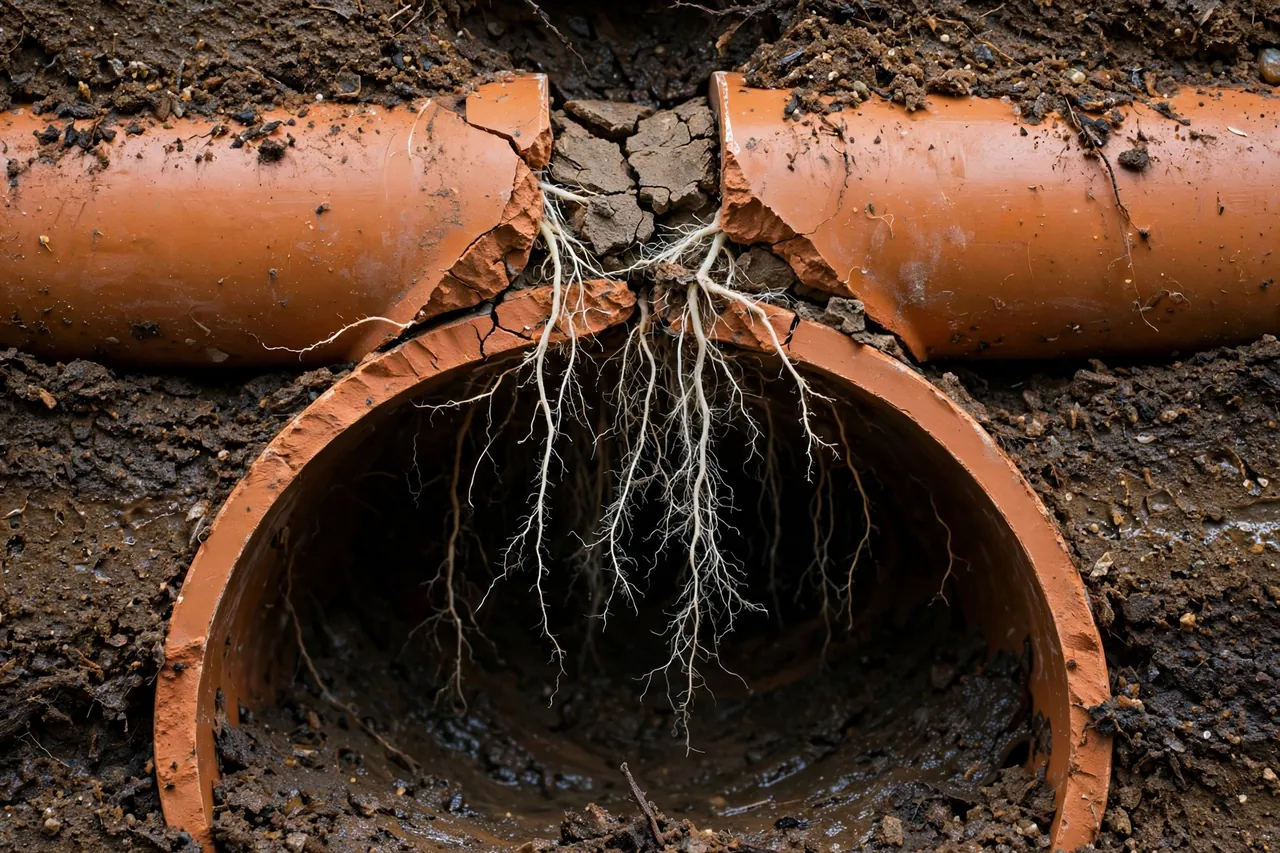
Roots do not break into pipes. They are invited in, and the invitation is water and nutrients leaking from an open joint. A live oak does not know there is a clay lateral under your yard; it senses moisture seeping from a point in the soil, carrying dissolved nitrogen and phosphorus. Root tips grow toward that gradient until they reach the source: a crack in a mortar joint.
The first root through the joint is a hair-thin feeder, and that is all it takes. Inside the pipe there is everything a plant wants: steady water, oxygen, and nutrients, in the dark and without competition. The root thickens, branches, and knots into a fibrous mass that can fill the pipe's diameter within a season or two, catching paper and solids until the line slows and backs up. The classic camera picture: a clean clay bore, then a joint, then a beard of roots hanging from the seam.
Live oaks, ficus trees, and banyans are the worst offenders, with root systems that can cross an entire yard to find a leaking joint. Citrus and podocarpus are milder but still opportunistic. If a large shade tree stands anywhere near the line's path from house to street, assume the roots have found every open joint. The tree roots in sewer lines guide maps the warning signs, and our tree roots in the sewer line page shows what intrusion looks like on camera. Cutting the roots clears the symptom; sealing the joints cures the cause.
The Warning Signs Your Clay Joints Have Root Intrusion
Root intrusion announces itself in a pattern. First the slow drain that fixes itself: the tub drains slowly on Tuesday, fine on Wednesday, because a root mass shifted and the flow found a new path. Then the recurring clog: a snake clears the line, everything works for a few months, and the same fixture backs up again. Roots grow back on a schedule, and no snaking changes the joint that let them in.
Next, several fixtures act up together. The toilet gurgles when the washer drains. The shower rises when the toilet flushes. One slow drain is a fixture problem; several at once is a main line problem, and in a clay-line home that points at the joints. Outside, look for the lush patch: a stripe of greener grass marking the line's path where leaking water fertilizes the lawn.
The end stage is the full backup, often during or after heavy rain when the already-full pipe cannot take extra inflow. At that point a hydro jetting service clears the line in one pass, gaining time and giving the camera a clean look at every joint. But treat the clearing as diagnosis, not repair. The roots return in months unless the joints get sealed. The camera maps exactly which joints are open and whether the clay segments are still round enough to line.
How Trenchless Lining Seals Every Clay Joint at Once
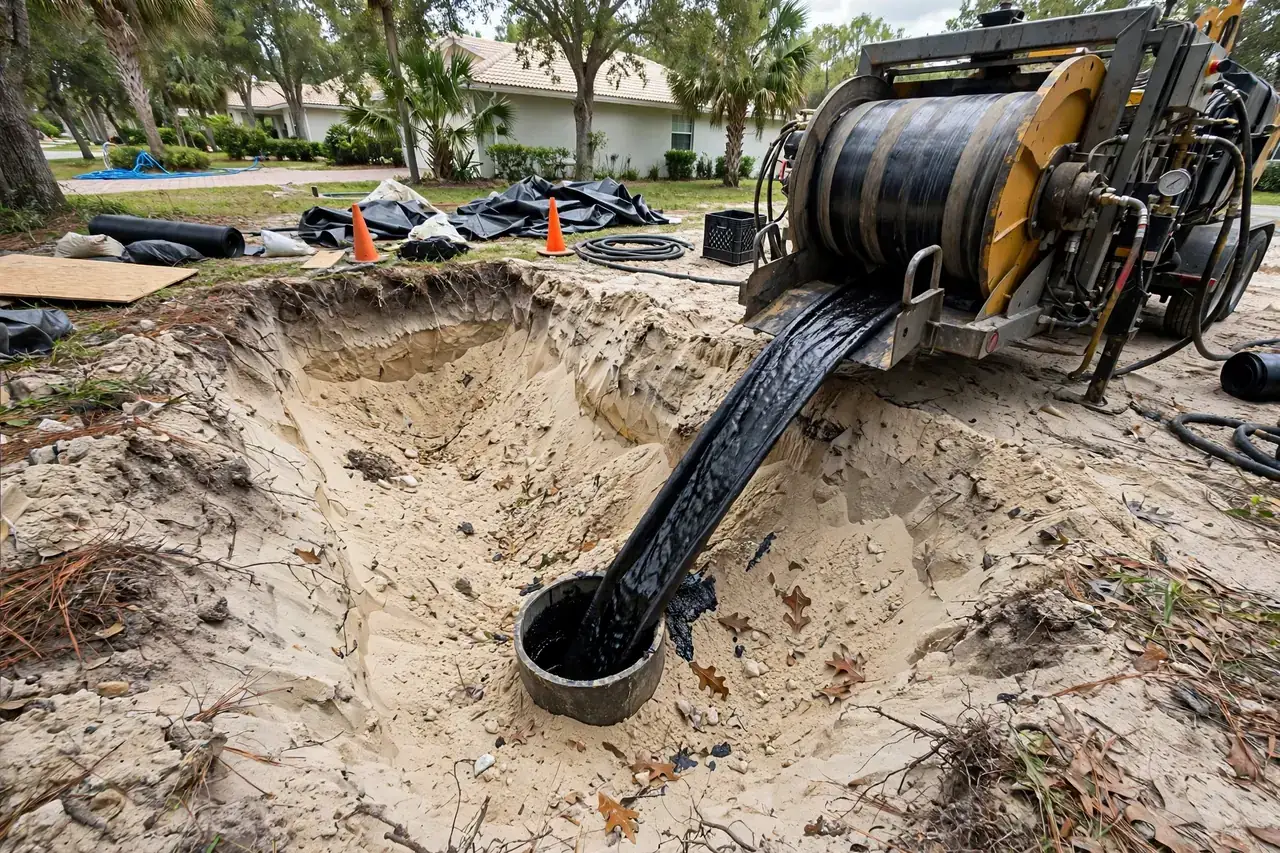
Cured-in-place pipe lining is the trenchless answer to joint failure, and clay is one of the best host pipes for it. After the line is cleaned to bare clay by hydro jetting and root cutting, a resin-saturated liner is inverted through a cleanout, inflated against the walls, and cured into a hard, seamless inner pipe. When it sets, it bridges every joint and crack with one continuous tube of new pipe inside the old.
This is exactly the fix joint failure needs. Roots cannot penetrate the liner because there are no seams left to penetrate. The host clay pipe, which was never the problem, becomes a protective shell around the new line, yielding a jointless lateral rated for decades of service with no trench across the yard.
Not every clay line qualifies, and this is where the camera earns its keep. If the segments are still round, the liner cures evenly against them. If sections have collapsed or joints are severely offset, the liner cannot bridge the gap, and sewer line replacement is the honest answer. Some jobs use both: lining the long runs and excavating the one failed section, still far less digging than a full trench. Our comparison of pipe bursting vs. pipe lining explains how to choose between the two trenchless methods.
Keeping Sarasota Clay Lines Root-Free After the Repair
Once the joints are sealed, the maintenance burden drops to nearly zero. A lined clay lateral has no seams for roots to exploit, and most homeowners never think about it again. Still, know where your line runs: the lateral takes the shortest practical path from house to street, and planting a new shade tree on top of that path is asking for joint problems a decade from now.
Be wary of chemical root killers as a long-term strategy. Copper sulfate and foaming herbicides kill the roots inside the pipe but leave the open joints that admitted them. The roots die, the treatment washes away, and new roots arrive within a season. Chemicals are a holding action between the first backup and the real repair, not an alternative to it. Mechanical cutting has the same limitation.
The real preventive step is the one-time inspection. If your Sarasota home was built before 1980 and still runs its original clay lateral, get the camera in the line before the backups start. You will get a map of every joint, a grade on each seam, and a straight answer about lining vs. replacement. Catching joints when they are separating, not after they have admitted a forest of roots, is the difference between a clean trenchless job and an emergency excavation. Call (941) 344-0088 and we will show you exactly what is down there, joint by joint.
Published 2026-11-03 · Sarasota Sewer Specialists
Related Sewer Services
CIPP Pipe Lining
CIPP pipe lining in Sarasota, FL creates a new pipe inside the old one: no trench. Camera inspection, cleaning…
Learn more →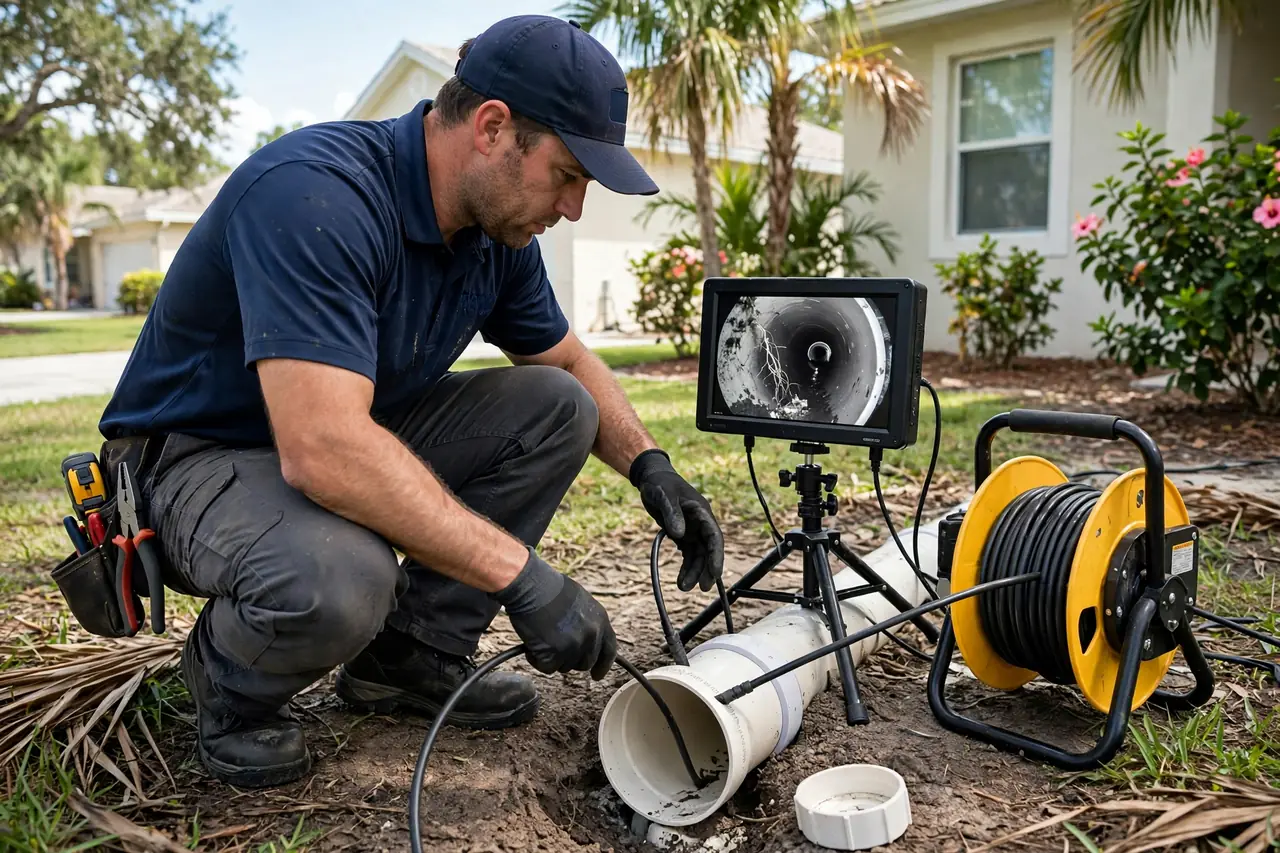
Sewer Camera Inspection
Sewer camera inspection in Sarasota, FL finds roots, scale, bellies & breaks before you dig. HD video diagnosi…
Learn more →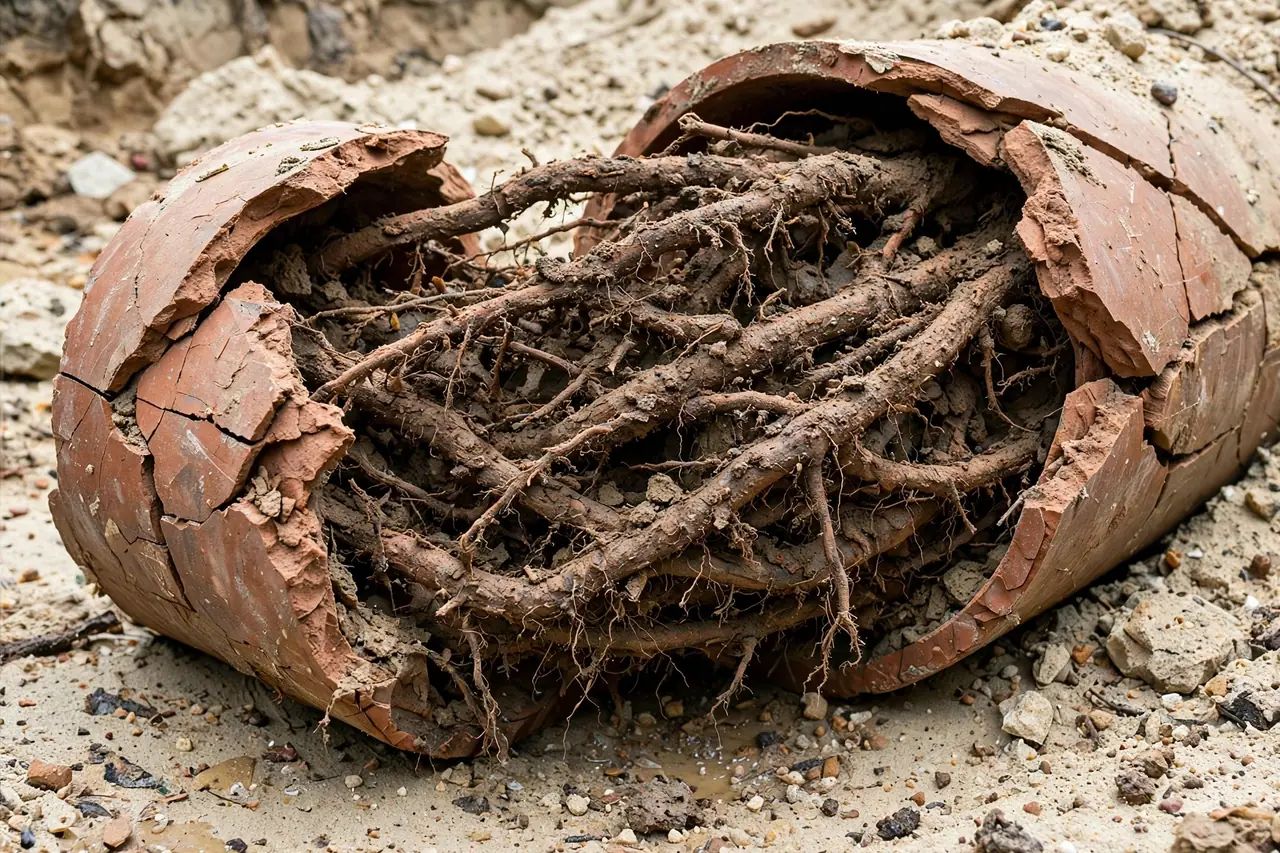
Tree Root Removal
Tree root removal for Sarasota sewer lines: cutting, jetting, and camera verification for live oak and ficus r…
Learn more →Nearby Service Areas
Frequently Asked Questions
How do I know if my sewer line is vitrified clay pipe?
If your Sarasota home was built between the 1940s and 1970s, vitrified clay is very likely. A camera inspection shows the telltale orange joints and the bell-shaped hubs.
Where do roots enter a clay sewer line?
At the joints. Clay segments are short, three to six feet, so a single lateral has many joints. Each one is a mortar-sealed seam that can shift, crack, and let roots in.
Can trenchless lining fix a clay pipe with root intrusion?
Yes, if the clay segments are still mostly round and intact. The liner bridges the open joints with a continuous inner pipe, and roots cannot penetrate it.
How long does clay sewer pipe last in Sarasota?
Clay pipe can last a century in stable ground. In Sarasota, sandy soil, high water, and root pressure cause joint failure long before the clay itself wears out.
Which Sarasota trees are worst for clay pipe joints?
Live oaks, ficus trees, banyans, and citrus are aggressive. Live oaks especially send roots dozens of feet toward the moisture and nutrients in a leaking joint.