Sewer Camera Inspection: What Sarasota Homeowners Should Expect
A sewer camera inspection is the single most informative service in the sewer trade: a live look inside your buried pipe, showing its material, its condition, and exactly where any problem sits. Here is how the process works, what the footage reveals, and why it matters before you buy an older Sarasota home.
What a Sewer Camera Inspection Actually Is
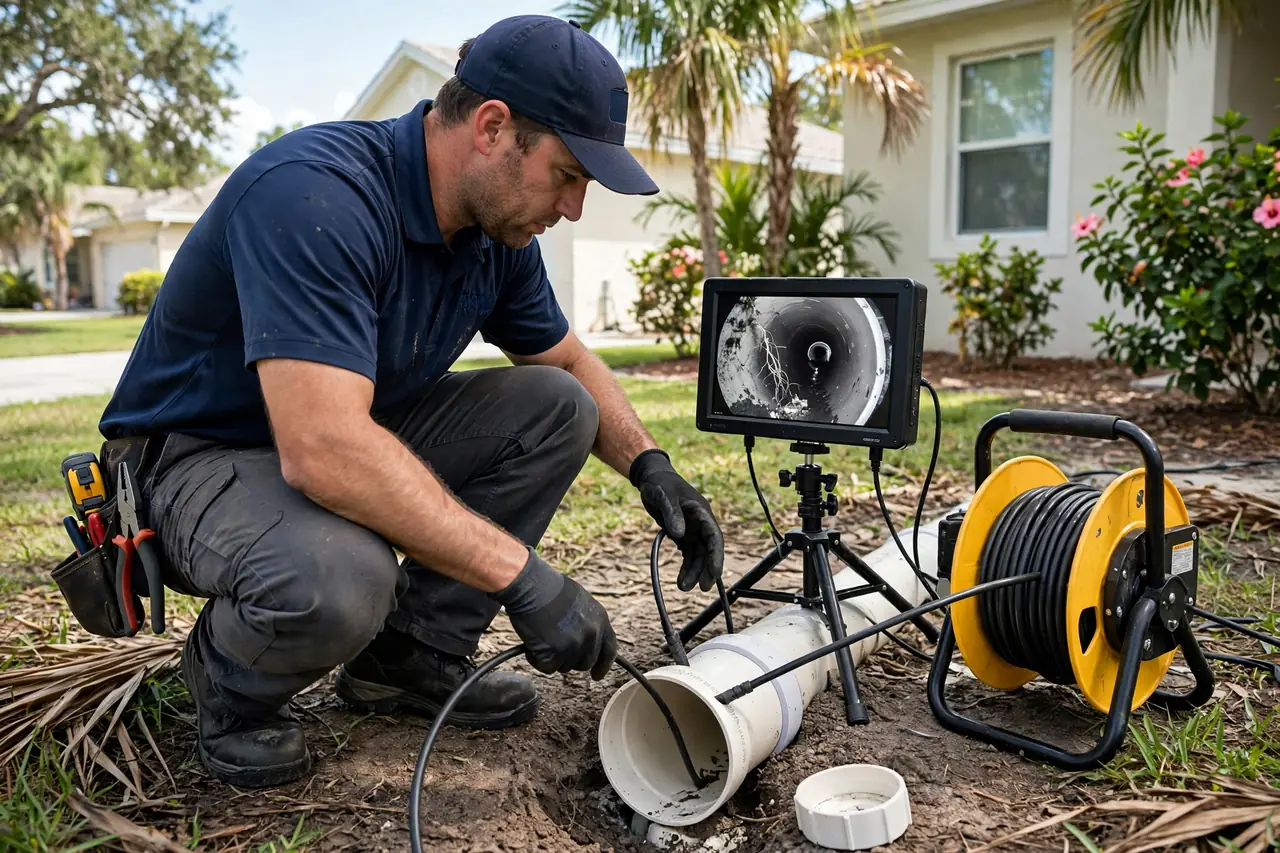
A sewer camera inspection sends a small waterproof camera through your sewer line and shows its interior on a monitor in real time. The camera head, about the size of a golf ball, with its own light ring, rides on the end of a flexible push rod that the technician feeds through the pipe from an access point. As the camera travels, you see exactly what it sees: the pipe walls, every joint, every defect, every change in material, with a footage counter showing how far into the line the camera has traveled.
Modern inspection cameras carry a transmitter in the head that broadcasts a signal to a receiver the technician holds at the surface. That means every problem the camera finds can be located precisely, its distance from the access point and its depth below grade, and marked on the ground with paint or flags. When the inspection is over, you know not just that there is a broken joint, but that it sits twenty-three feet from the cleanout, four feet down, under the edge of the driveway. That precision is what turns a diagnosis into a repair plan.
What the inspection is not: it is not a guess, an estimate, or a sales pitch. It is a recording of the physical condition of your pipe. Reputable companies give you the footage to keep, because the footage is the product, everything else is interpretation. If you take one thing from this article, take this: never authorize a major sewer repair in Sarasota without a camera inspection first. The ground here hides too many variables, bellies in saturated sand, root masses at clay joints, scale in old cast iron, for any diagnosis made from above ground to be reliable.
The Step-by-Step Process
Knowing what happens during the visit takes the mystery out of it. Here is the process from the technician's arrival to the final report.
Finding Access
The technician starts by locating your cleanout, the capped pipe that gives direct access to the sewer line. In Sarasota homes it is usually outside near a bathroom wall, in a flower bed, or at the property line, sometimes buried under mulch or sod. If the home has no accessible cleanout, the camera can often go through a pulled toilet or down a roof vent, though the view is more limited and the setup takes longer. This is also why plumbers keep recommending cleanout installation: every future service gets easier with direct access.
Running the Camera
With the cleanout open, the technician feeds the push rod into the line, usually running downstream toward the street or the main connection first, then pulling back slowly for the recorded pass. The monitor shows the pipe interior live, and most technicians narrate what they are seeing as they go, this is your chance to watch your own pipe on the screen and ask questions in real time. The camera moves at a walking pace or slower; rushing the pass is how defects get missed.
Locating and Marking
Whenever the camera finds something worth noting, a cracked joint, a belly, a root mass, a material transition, the technician stops, and the surface receiver pinpoints the camera's position. The spot gets marked on the ground and noted with its depth and distance. By the end of the run, there is a map: every defect located in three dimensions, which is exactly what a repair crew needs to plan pits, estimate excavation, or confirm that a trenchless method can reach the problem.
The Report
A proper inspection ends with findings you can keep: the video file, a summary of the pipe's material and overall condition, each defect described and located, and a recommendation for next steps. The recommendation should reference the footage, line it, burst it, excavate this section, jet it and recheck in a year, not a generic menu. If the line is in good shape, the report says so, and the footage becomes the baseline that every future inspection is compared against.
What the Footage Reveals
To an untrained eye, sewer camera footage looks like a slow ride through an orange-brown tunnel. To a technician, it reads like a medical scan. Here is what the camera finds in Sarasota lines, roughly in order of how often it appears.
Scale and Corrosion in Cast Iron
In the 1960s to 80s slab homes of Gulf Gate, Bee Ridge, and similar subdivisions, the camera usually finds cast-iron DWV with internal scale, rough mineral crust narrowing the pipe, and varying degrees of corrosion. Advanced cases show channeling, where the bottom of the pipe has worn into a groove, and pitting where the metal is flaking. The camera distinguishes cosmetic aging from structural failure: uniform light scale is a cleaning matter; deep channeling with thin remaining metal is a replacement conversation. Our guide to cast-iron pipe in Sarasota slab homes covers this failure mode in detail.
Bellies and Standing Water
A belly, a sagged section where the pipe has settled, announces itself unmistakably: the camera lens dips below the waterline and the picture clouds with standing wastewater. Bellies are common in Sarasota because saturated Myakka fine sand shifts bedding unevenly, and the seasonally high water table, 0 to 3.5 feet below grade, keeps the ground soft for months each year. A shallow belly that still drains is worth monitoring; a deep belly that holds water around the clock is a repair candidate, because standing wastewater corrodes pipe faster than flowing wastewater.
Root Intrusion
Roots appear as white feeder strands at first, then woody growth, then full root balls filling the pipe. The camera shows exactly which joints are breached, in clay tile laterals, often several along the run, and whether the pipe around them is still sound. Sarasota's mature live oaks and ficus trees make this one of the most common findings in older neighborhoods, and the footage determines whether the answer is cutting, lining, or replacement.
Cracks, Separations, and Infiltration
Separated joints show as visible gaps with soil or roots visible beyond the pipe wall. Cracks appear as dark lines across the pipe interior, sometimes weeping groundwater, the camera can actually show water entering the pipe, which is infiltration in real time. After rainy-season storms, inspections frequently find silt deposits downstream of these entry points, the fine sand that groundwater drags in with it. Each of these findings points at a specific repair, which is the whole value of the inspection: the footage replaces guesswork with a parts list.
Smart Before Buying an Older Sarasota Home
Here is the scenario the inspection was made for. You are buying a 1974 ranch in downtown Sarasota or a 1968 slab home near Gulf Gate, solid house, good bones, original plumbing. The general home inspector checks the visible plumbing, runs the fixtures, and reports that everything drains. What the general inspection does not do, ever, is evaluate the buried sewer line. The pipe under the slab and the lateral to the street are the most expensive hidden components of the house, and they are invisible to every part of a standard inspection.
A pre-purchase sewer camera inspection fills that gap completely. In under two hours, you learn the pipe's material, its condition along the full run, and whether the line needs cleaning, repair, or replacement, and roughly what that work involves. That information has real negotiating value: a line that needs replacement is a five-figure consideration, and knowing about it before closing is the difference between negotiating the repair and discovering it with your first backup.
Sellers and listing agents in Sarasota's older neighborhoods are increasingly familiar with the request, and it is a reasonable contingency item. The inspection is non-invasive, no digging, no damage, just a camera through the cleanout, so there is no reason for a seller to refuse it beyond not wanting the answer. If you are buying in the 1960s to 80s slab cohort, treat the sewer scope the way you treat the roof inspection: a standard part of due diligence on a house old enough to have original pipe.
How Often Should You Schedule One
For most Sarasota homeowners, a sewer camera inspection every two to three years is a sensible rhythm, more often if the line is old clay or cast iron, has a history of root intrusion, or runs through heavily landscaped ground where mature trees press against it. The inspection is quick and non-invasive, so there is no penalty for doing it on a schedule rather than waiting for symptoms.
Certain moments call for an inspection outside the routine. Before the rainy season, April or May, a scope shows what the June-through-September storms will find: the separations and bellies that saturated soil will exploit. After any backup, even one that cleared on its own, a scope shows what caused it and whether it will recur. After major storm flooding, like the inland flooding Tropical Storm Debby brought to parts of the county in August 2024, a scope checks whether the saturated ground shifted anything. And after any repair, the post-repair footage is your new baseline, keep it, because every future inspection is measured against it.
One more timing note for the historic neighborhoods: if your home dates to the 1920s to 40s core or the 1950s to 60s tracts and the lateral has never been scoped, the first inspection is overdue regardless of symptoms. Clay tile laterals from those eras have been in the ground for half a century or more in shifting sandy soil. Finding out what shape they are in is not alarmism; it is the same logic as checking the roof on a fifty-year-old house.
What Happens After the Inspection
The inspection ends, the technician packs up, and you have footage and a report. What comes next depends on what the camera found, and the honest range of outcomes is wider than most homeowners expect.
The best outcome is also the most common for well-maintained lines: the pipe is sound, maybe with light scale or minor root hairs, and the recommendation is cleaning and a recheck in a couple of years. A hydro-jetting service scours the scale and clears the early roots, restoring full flow, and the post-cleaning footage confirms the pipe underneath is healthy. This is the inspection paying for itself: a modest maintenance visit instead of an emergency call later.
The middle outcome is a defined repair: a breached joint to line, a root mass to cut and then line, a bellied section to address. Because every defect was located and measured, the repair plan is specific, which method, which section, what access is needed, and you can get comparable quotes against the same footage. Show the video to every contractor you call. It eliminates the guesswork from bidding and the surprises from execution.
The serious outcome is a line at the end of its life: widespread channeling in cast iron, multiple collapsed clay sections, a lateral that has lost its slope. Even here, the inspection has done its job, you are choosing a trenchless repair or a conventional replacement with full knowledge of the pipe's condition, not reacting to a catastrophic backup with no information. And if you are the buyer in a purchase transaction, this is the report that goes to the negotiating table.
Whatever the outcome, keep the footage. Store it with your home records next to the roof and HVAC documentation. The next inspector, or the next owner, will thank you, and you will have the one thing no Sarasota homeowner should be without: a clear picture of what is happening under their yard.
Published 2026-10-09 · Sarasota Sewer Specialists
Related Sewer Services
Sewer Camera Inspection
Sewer camera inspection in Sarasota, FL finds roots, scale, bellies & breaks before you dig. HD video diagnosi…
Learn more →Sewer Odor Detection
Sewer odor detection in Sarasota, FL. We find the source of sewer gas smells: vents, traps, laterals. Call (94…
Learn more →Nearby Service Areas
Frequently Asked Questions
How often should a Sarasota homeowner have the sewer line inspected?
For most homes, every two to three years is a sensible interval, more often if the line is old clay or cast iron, has a history of root intrusion, or runs through heavily landscaped ground. The inspection is quick and non-invasive, so there is no penalty for doing it on a schedule. After any repair, the post-repair footage becomes your new baseline, and the next inspection is measured against it.
What if my home does not have a sewer cleanout?
Yes. Older Sarasota homes often lack a modern cleanout, and the camera can still be run through a pulled toilet or a roof vent in many cases, though it is slower and the view is more limited. If your home has no accessible cleanout, having one installed is a worthwhile improvement: every future inspection, cleaning, and repair gets faster and less invasive with direct access to the line.
Should I get a sewer inspection when buying an older Sarasota home?
Absolutely. In fact, it is one of the best uses of the service. Sarasota's housing stock includes large numbers of 1960s to 80s slab homes with original cast-iron DWV and clay or cast-iron laterals, the prime failure cohort. A pre-purchase inspection shows the material, the condition, and the repair outlook before you commit, when there is still room to negotiate.
Can an inspection predict rainy-season backup problems?
It can. The camera sees standing water in bellied sections, silt deposits from infiltration, and the cracks and separations that let groundwater in, all of which predict rainy-season trouble. A line that looks marginal in the dry season is the line most likely to struggle in August. Spring inspections, before the June rains, are the ideal timing for exactly this reason.
How long does a sewer camera inspection take?
It depends on the line's length and access, but the field work for a typical residential inspection is usually completed within an hour or two, and you get the findings the same visit, often while watching the monitor yourself. Ask for a copy of the footage to keep; it is the baseline for every future inspection and useful documentation if you sell the home.