
How Long Do Sewer Lines Last in Florida?
Ask how long a sewer line lasts and you will get a national average. That average was not calculated in Florida. High water tables, sandy soil, and fifty inches of annual rain rewrite the math.
Cast iron lasts 50 to 80 years nationally, often 40 to 60 in Florida. Clay tile lasts 50 to 60 years, though the joints usually fail before the tile does, and PVC lasts 100 years or more. In Sarasota, a water table 0 to 3.5 feet below grade, 49 to 53 inches of annual rain, and aggressive roots shave years off every material except PVC. A camera inspection confirms your pipe material and where it sits on its timeline.
Sewer Pipe Lifespan by Material
Cast iron: 50 to 80 years nationally, often 40 to 60 in Florida. Clay tile: 50 to 60 years, though the joints usually fail before the tile does. PVC: 100 years or more, the modern standard. Orangeburg (bituminized fiber pipe, common from the 1940s to 1970s): 30 to 50 years, and it is past due everywhere it still exists.
These are service lives, not warranties. A cast-iron line does not fail on its 60th birthday. It fails when corrosion, soil movement, and root pressure together exceed what the remaining wall can carry. In Sarasota, that convergence arrives earlier than national numbers suggest, which is why material plus local conditions, not material alone, sets your real timeline.
Why Florida Shortens the Numbers
Start with the water table. Across much of Sarasota County it sits 0 to 3.5 feet below the surface in the rainy season, so many laterals spend months each year effectively underwater. Constant moisture accelerates exterior corrosion on cast iron and softens the soil bedding that holds every pipe type in alignment.
Then add the rain itself: 49 to 53 inches a year, most of it June through September. Saturated sand shifts and settles, stressing joints and creating bellies. Aggressive subtropical roots hunt the moisture inside clay joints year-round. None of these factors appear in a national lifespan table, and together they shave years off every material except PVC.
Cast Iron Under the Slab: Sarasota's Biggest Cohort
The largest group of aging sewer lines in Sarasota is cast iron installed under slabs from the 1960s through 1980s, in neighborhoods like Gulf Gate and Southgate and Pinecraft. Inside, decades of flow build tuberculation, rough scale that narrows the pipe and snags debris. Outside, decades of soil moisture thin the wall.
A 1975 cast-iron lateral is now 50 years old, squarely in the Florida failure window. Camera inspections on these lines tell a consistent story: heavy scale, channeling along the bottom, and cracks at the joints. If your home dates from this era and the line has never been inspected, a sewer camera inspection is the fastest way to learn where your pipe sits on its timeline.
Clay Tile Laterals and the Joint Problem
Clay tile itself is nearly indestructible. The joints are the weakness. Laid in 3 to 4 foot sections, a clay lateral has a joint every few feet, and each joint invites roots. Once roots enter, they widen the joint, the sections shift, and the watertight line becomes a root farm.
Many Sarasota ranch homes from the 1950s and 60s still run original clay laterals to the street. These lines can look fine from the surface while roots quietly occupy half the pipe. Regular camera checks catch joint intrusion early, when hydro jetting and root treatment still gain meaningful time.
Orangeburg Pipe: The Material With the Shortest Fuse
Of every pipe material in Sarasota, Orangeburg has the least time left. Bituminized fiber pipe, essentially tar-soaked wood pulp rolled into a tube, went into thousands of homes from the 1940s through the 1970s as a lightweight wartime and postwar alternative to metal. It was never meant to last. Under soil pressure it deforms from round to oval, blisters on the inside, and eventually collapses flat. Any Orangeburg still in the ground is past its 30 to 50 year design life, some of it by decades.
The tricky part is that Orangeburg can look fine until it does not. A camera is the only reliable check: deformed, oval, or flattened sections are unmistakable on footage. If your home dates from that era and you have never had the line inspected, our guide to Orangeburg pipe in Sarasota's older homes covers identification in detail. A camera inspection settles it in one visit, and finding Orangeburg early means planning a replacement instead of reacting to a collapse.
Signs Your Line Is Nearing the End of Its Life
Age plus material gives the estimate, and symptoms give the confirmation. Watch for the cluster: clearings needed more than once a year, two or more fixtures slowing together, gurgling that tracks the rainy season, and odors near the cleanout. One symptom has innocent explanations. Three together on a 50-year-old cast-iron line is a timeline running out.
The camera is the tiebreaker. Scale you can see, cracks you can see, deformation you can see. A line with light scale and sound walls has years left. A line with heavy tuberculation, channeling, and separated joints is living on borrowed time, and planning its replacement on your schedule beats planning it during an emergency.
Can You Extend Your Sewer Line's Life?
Maintenance gains time, not immortality. Periodic hydro jetting clears scale and roots before they harden into permanent restrictions. Keeping large trees away from the lateral's path denies roots their target. Fixing small leaks early prevents the soil washout that leads to bellies and breaks.
For a structurally sound but aging line, CIPP pipe lining is the closest thing to a life extension: a resin liner cured inside the old pipe creates a smooth, jointless new channel. Lining needs an intact host pipe, so the camera decides candidacy. It will not save a collapsed line, but it can retire a merely old one from the replacement list.
Planning Replacement Before the Emergency
The smoothest sewer replacement is the one you plan. Start with a camera inspection on a schedule that matches your pipe's age: every three to five years once cast iron or clay passes 40, every two years past 50. The footage becomes a baseline. When the next inspection shows new deformation, heavier scale, or fresh root intrusion, you have a timeline instead of a surprise.
Planning also opens up options that emergencies close off. A scheduled project lets you compare trenchless vs. traditional repair calmly, get the work done in dry season when the ground is firm, and coordinate with any landscaping you already had in mind. Learn the difference between pipe bursting and pipe lining before you need either, so the decision is familiar when the footage says it is time. And keep watching for the signs of sewer line failure between inspections; the camera sees the pipe, but you live with the drains every day.
When Replacement Makes More Sense Than Repair
Every aging line reaches a crossover point: the year when the next repair demands more than the years it adds. Repeated clearings, spot repairs on successive sections, and emergency calls add up, and each one leaves the remaining old pipe exactly as old as it was.
Trenchless replacement resets the clock with modern materials, usually PVC or HDPE with a century-scale service life, without trenching the yard. If your line is past 50 years, failing in multiple spots, or backing up every rainy season, replacement is not the drastic option. It is the option that ends the cycle of repairs. Call (941) 344-0088 to discuss what your camera footage shows.
What a New Line Gives You: The Next 100 Years
A modern replacement, usually PVC or HDPE, resets the clock in a way repairs cannot. PVC carries a 100-plus-year service life rating. HDPE, the flexible pipe pulled through during pipe bursting, is jointless along its entire run, which removes the exact weak point where roots destroyed your clay tile. Smooth walls resist the scale buildup that choked old cast iron, and the materials do not corrode in wet soil.
A century rating is not a promise nothing can go wrong. Poor bedding during installation, heavy vehicles driving over a shallow line, or construction damage can still cause trouble, which is why the installer's workmanship matters as much as the material. But the failure modes that took down your old line, corrosion, joint separation, root intrusion at every coupling, are engineered out. Compare that with the cast-iron lines under Sarasota slabs it replaces, and the difference is a pipe you will likely never think about again. Keep trees planted away from the new route, and the root problems that plagued the old line stay in the past.
Published 2026-10-18 · Sarasota Sewer Specialists
Related Sewer Services
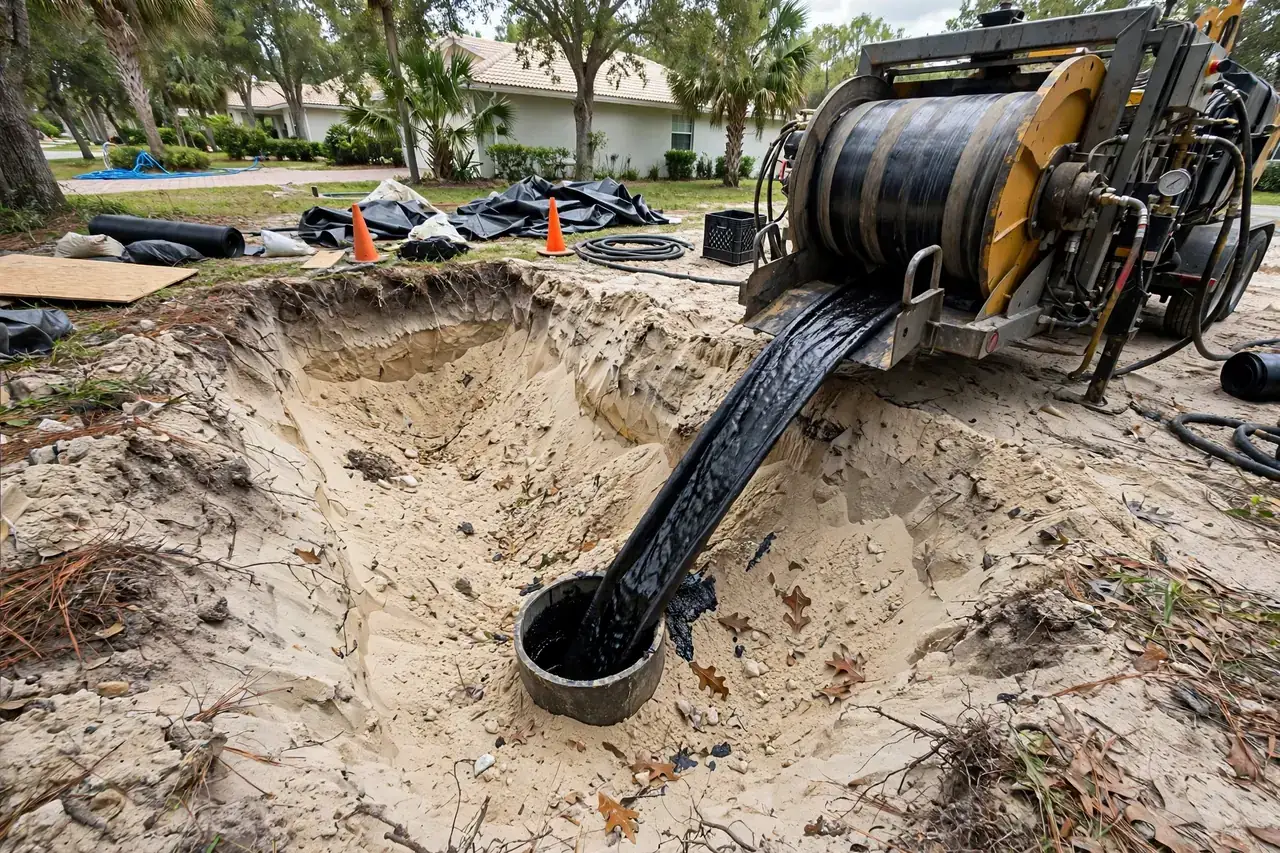
CIPP Pipe Lining
CIPP pipe lining in Sarasota, FL adds decades to an aging line: a jointless new pipe cured inside the old one, no digging.
Learn more →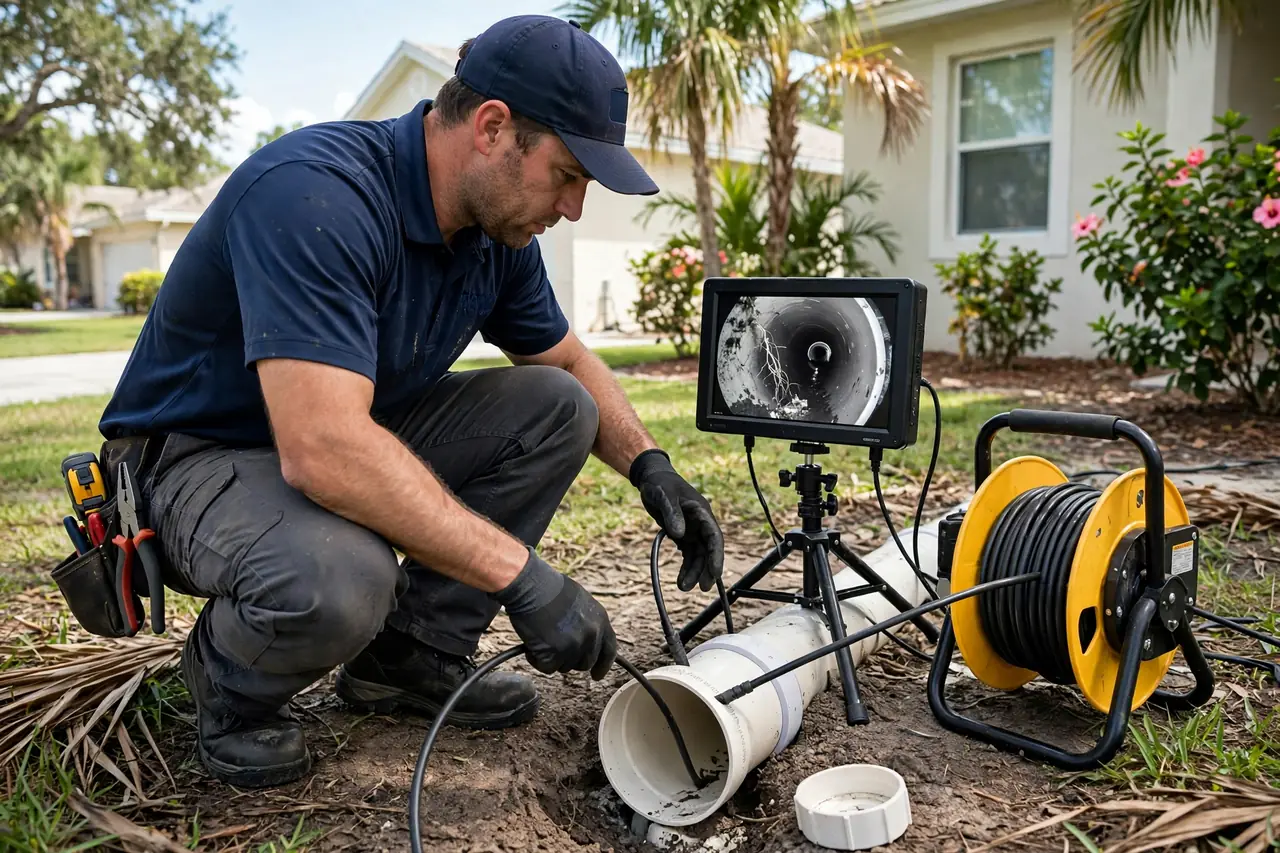
Sewer Camera Inspection
HD sewer camera inspection in Sarasota, FL grades your pipe's real condition: see exactly how much life it has left.
Learn more →Nearby Service Areas
Frequently Asked Questions
How long do cast iron sewer pipes last in Florida?
Nationally, 50 to 80 years. In Florida, plan on 40 to 60, sometimes less under slabs where soil moisture never lets up. Sarasota's 1960s to 1980s subdivisions are living through this window right now. A camera inspection shows whether your line is aging gracefully or corroding ahead of schedule.
Does PVC sewer pipe really last 100 years in Florida soil?
PVC does not corrode, scale, or feed roots, so its lifespan comes down mostly to installation quality: proper bedding, correct slope, and sound joints. A well-installed PVC lateral in stable soil is the closest thing to a permanent sewer line Florida offers.
How do I find out what material my sewer line is made of?
Your home's build decade is the first clue: pre-1960 often means clay tile, the 1960s through 1980s usually means cast iron, and the 1990s onward is typically PVC. A camera inspection confirms it visually, since each material looks distinct on screen.
Can a camera inspection tell me how much life my pipe has left?
It gives the best available answer. The technician grades what the footage shows: wall condition, scale buildup, joint integrity, deformation, and root intrusion. That condition report, combined with the pipe's age and material, is how professionals estimate remaining service life.
Is pipe lining a good option for an aging but intact line?
Yes, when the host pipe still holds its shape. CIPP lining creates a new jointless pipe inside the old one, sealing cracks and blocking roots, adding decades of service without excavation. Collapsed or severely deformed sections do not qualify, which the camera determines.
Should I replace my sewer line before selling my Sarasota home?
Not automatically, but know its condition before listing. Buyers increasingly request sewer camera inspections, especially on pre-1980 homes, and a failing line found at inspection becomes leverage against you. A clean camera report, or a proactively replaced line, removes the issue entirely.