Sewer Odor Detection in Sarasota, FL
A sewer smell inside or around your home means gas is escaping the plumbing system somewhere it should not. We track it to its source, dry traps, cracked vents, or a failing lateral, instead of guessing.
Why Sewer Odor Happens
Every drain in a building connects to pipes that carry waste to the sewer. As that waste breaks down, it produces gases, mostly methane and hydrogen sulfide. Plumbing systems are designed to keep those gases inside the pipes and vent them safely above the roofline. Odor means one of those two jobs is failing: either gas is escaping through a gap it should not cross, or the water seals that block it have dried out.
The tricky part is that sewer gas wanders. Gas from a broken lateral underground can rise through soil and enter through foundation gaps far from the break. Gas from a cracked vent in an attic can drift down wall cavities and surface in a room below. That is why odor detection is a diagnostic process, not a sniff test. Call (941) 344-0088 if a sewer smell keeps returning no matter what you clean.
Dry Traps: The Simplest Cause
Every fixture has a curved section of pipe, a trap, that holds a plug of water. That water is the only barrier between your living space and the sewer gases in the pipes. In guest bathrooms, floor drains, and laundry rooms that go weeks without use, the water in the trap evaporates. Once the seal is gone, gas flows freely up through the drain.
Dry traps are the first thing to check because the fix takes thirty seconds: run water into every drain, including the ones you never use. In Sarasota, this cause is especially common in seasonal homes. A house that sits empty from April through December can have multiple dried traps when its owners return, and the first complaint is always the smell. If running water into every drain clears the odor within a day, you found it. If the odor survives a full day after all traps are wet, the source is somewhere else in the system.
Cracked Vent Stacks
Vent pipes run from the drain system up through the roof, equalizing pressure so drains flow and directing gases safely outside. When a vent stack cracks, from age, corrosion, or storm damage, gas escapes into attics, wall cavities, and chase spaces instead of rising out the roof. The odor then appears inside the home at the weakest point of the building envelope, which is rarely near the actual crack.
Cast-iron vent stacks in Sarasota's older homes are prime suspects. Decades of condensation inside the pipe corrode it from within, and the corrosion works fastest in the humid air of an unconditioned attic. A cracked vent can also pull gas into the house through the air conditioning: as the AC creates negative indoor pressure, it draws air, including sewer gas, through every unsealed gap in walls and ceilings. Odors that intensify when the AC kicks on are a classic vent-stack symptom.
Vent problems also change how fixtures behave. A blocked or cracked vent can cause drains to gurgle and toilets to lose their trap water on flushing, which then dries the traps and multiplies the odor. Venting, traps, and odor are one connected system, and detection has to treat them that way.
Broken Laterals and Failing Joints
The sewer lateral, the pipe connecting the house to the municipal main, is the longest and most vulnerable part of a home's plumbing. In Sarasota, laterals face a particular set of stresses. Saturated sandy soil loses its support under pipes, causing sections to sag into bellies and joints to pull apart. High groundwater then infiltrates through the open joints, carrying fine sand with it.
A broken or separated lateral releases sewer gas into the surrounding soil. From there the gas migrates upward and can surface through the ground, through foundation cracks, or into the crawl spaces of raised homes. The outdoor version of this is the yard that smells faintly of sewage after rain, especially over the path of the lateral from the house to the street. Because groundwater rises to within a few feet of the surface in much of Sarasota County, even a modest break can produce a noticeable odor, and heavy rain makes it worse by pushing gas ahead of the rising water.
Under-slab cast-iron failures in the 1960s to 1980s slab subdivisions around Gulf Gate and Bee Ridge are another lateral-side source. Corroded cast-iron joints under the slab can leak gas that enters through slab cracks, plumbing penetrations, and the gaps around the toilet flange. When a whole house carries a faint sewage odor that no amount of cleaning removes, the pipe under the floor is where detection starts. A sewer camera inspection is the way to see it.
Why Odors Worsen in Sarasota's Heat
Several Florida-specific conditions conspire against odor control, and they explain why sewer smells peak in the hot months.
Heat Accelerates Evaporation
Sarasota's summer heat dries out rarely used traps faster than most homeowners expect. A guest-bath trap that holds its water seal for months in a cooler climate can lose it in weeks here, especially in an unconditioned room. Seasonal homes are hit hardest: months of vacancy plus summer heat equals dried traps throughout the house.
Heat Increases Gas Pressure
Warm air expands, and warm sewage produces more gas. As ground and pipe temperatures rise, the pressure inside the sewer system increases, pushing gas through any available opening, dry traps, cracked vents, loose seals, with more force than in cooler months. A marginal gap that leaks nothing in January can smell strongly in August.
Rain Raises the Water Table
The rainy season from June through September lifts an already high water table toward the surface. Rising groundwater pressurizes cracked laterals from the outside, forcing sewer gas out through breaks and up through the soil. August, the wettest month, is also typically the peak month for outdoor sewer odor complaints around failing laterals. When the rain stops and the water table drops, the odor often fades, until the next downpour.
Air Conditioning Creates Suction
Florida homes run their air conditioning hard for most of the year. The constant cooling cycle maintains slight negative pressure indoors, which steadily draws air in through every unsealed opening in the building envelope, including openings into the plumbing system. A cracked vent or dried trap that might leak a little gas passively leaks a lot under continuous AC suction.
Our Systematic Detection Process
Because gas wanders, detection follows a fixed sequence that narrows the source step by step. We do not start by digging or cutting into walls; we start by eliminating the simple causes and then escalate only as far as the evidence requires.
Step One: Interview and Pattern Log
Before touching a pipe, we ask when the odor appears, where it is strongest, whether the AC is running, and whether it tracks with rain. A pattern, worse in August, strongest in the guest bath, present only when the air handler runs, is itself diagnostic. If you have noticed a pattern, write it down before we arrive; it shortens the process considerably.
Step Two: Trap and Fixture Check
Every drain in the affected area is run to refill its trap, and fixtures are inspected for loose seals, failed wax rings at toilets, and uncapped cleanouts. A surprising number of odor jobs end here with a thirty-second fix.
Step Three: Vent Inspection
Vent stacks are inspected from the roof and, where accessible, from the attic. We look for cracks, separations, and blockages, and we check that vents actually terminate above the roofline rather than inside the attic, a shortcut some older builds took. A vent that ends in the attic has been venting sewer gas into the house for decades.
Step Four: Smoke Testing
When the source still is not found, smoke testing shows exactly where gas is leaving the system. Non-toxic theatrical smoke is introduced into the drain system under light pressure, and wherever smoke emerges, from a vent, a wall, a floor drain, a yard, gas is escaping too. Smoke makes the invisible path visible and eliminates the guesswork from locating breaks.
Step Five: Camera Inspection
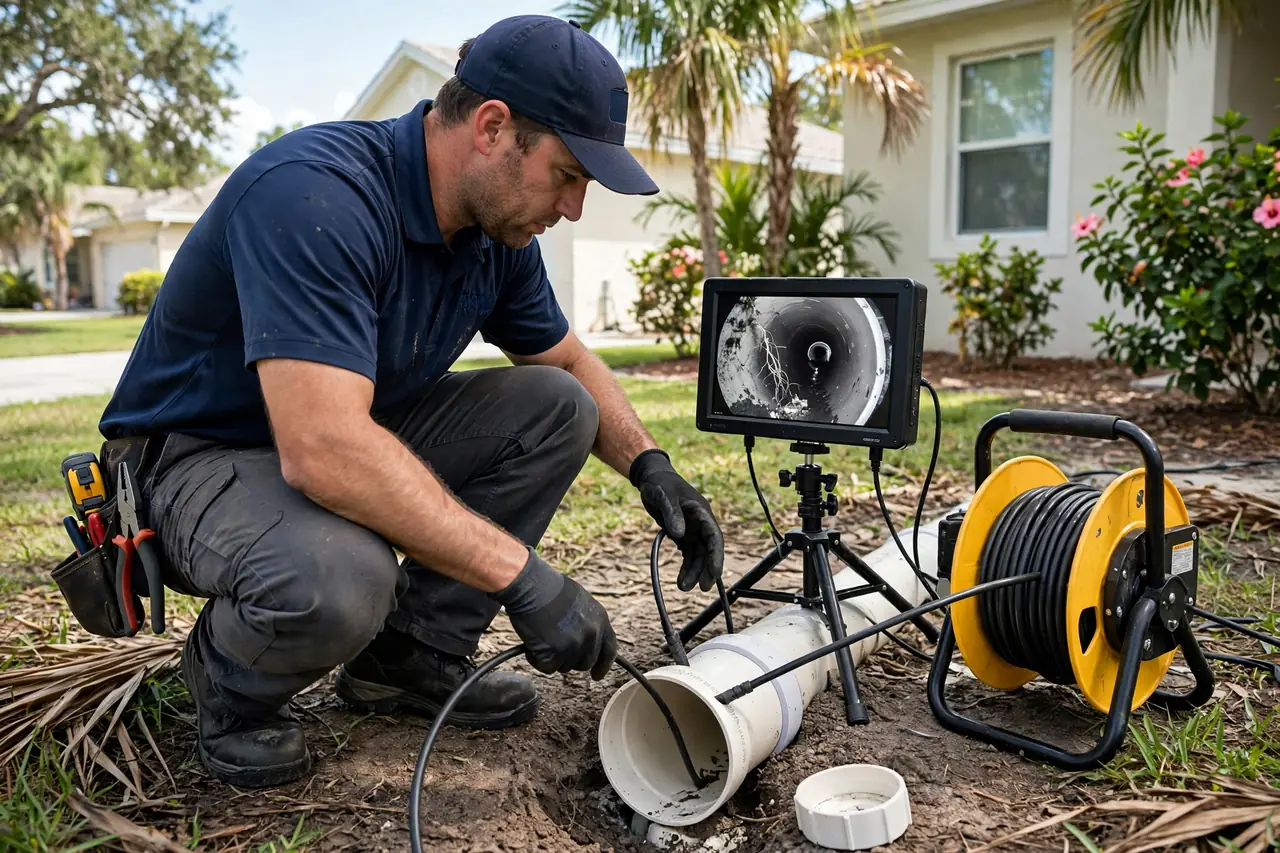
If smoke points to the lateral, a camera inspection reveals the pipe's interior condition: cracks, separated joints, bellies, and root intrusion that all serve as gas escape routes. The camera footage also determines the repair, whether the answer is trenchless repair, spot repair, or full line replacement.
Odors That Come and Go
Intermittent odors are the most confusing kind, but they usually have an explanation. Wind direction matters: a downdraft over the roof can push vented gas back down toward windows and doors on the downwind side. Barometric pressure swings do the same thing, falling pressure lets gas expand out of the system more readily.
Municipal sewer activity can push gas into home laterals. When the city jets a main or a nearby pump station cycles, pressure waves travel through the sewer and can force gas past weak traps in connected homes. If several neighbors smell it on the same day, the source may be municipal work rather than your plumbing.
The rule of thumb: odors tied to weather or municipal activity come and go, while odors tied to your plumbing persist. A smell that is present every day, in the same spot, through every weather pattern, is your house telling you something. A smell that visits for an afternoon and leaves is usually the atmosphere playing with the vents.
When an Odor Means a Bigger Problem
Some odors are symptoms of failures that will not fix themselves. A persistent sewage smell combined with slow drains throughout the house points to a lateral that is both leaking gas and losing capacity, often a broken clay joint or a bellied section in saturated soil. Odor plus visible sewage or wet spots in the yard means the break has reached the surface and the repair cannot wait.
Under-slab cast-iron failures announce themselves with a chronic whole-house odor and, eventually, with drain problems as the corroded pipe collapses. These homes need the pipe addressed, not the smell masked. And any strong gas odor that arrives suddenly after a storm deserves prompt attention: storm-shifted soil in an area with a high water table can open joints that were previously holding, and the window between "smells bad" and "backs up" can be short. Call (941) 344-0088, we will find the source before it finds your floors.
Sewer Odor Detection Across Sarasota
We bring sewer odor detection to homes throughout Sarasota and nearby Gulf Coast cities.
Related Reading
7 Signs Your Sewer Line Is Failing (Sarasota Edition)
Seven signs your Sarasota sewer line is failing: slow drains, gurgling, odors, and backups. Call (941) 344-008…
Learn more →Sewer Camera Inspection: What Sarasota Homeowners Should Expect
What a sewer camera inspection in Sarasota shows: the process, the footage, and why it matters. Call (941) 344…
Learn more →Frequently Asked Questions
What is sewer gas and why can I smell it?
Sewer gas is mainly methane and hydrogen sulfide, which smells like rotten eggs even in tiny amounts. The gas forms naturally as waste breaks down in the sewer system. Healthy plumbing traps water in curved sections of pipe, the traps under sinks and in floor drains, which blocks the gas from rising into the home. When a trap dries out or a vent cracks, that barrier disappears.
Is there a quick check I can do before calling?
Start with the easiest check: run water into every drain in the room for thirty seconds, including floor drains and rarely used sinks. If the odor fades within a day, a dry trap was the cause. If the smell persists or comes from one specific fixture after running water, a vent or lateral issue is more likely and deserves a professional look.
Does the location of the smell tell you where the problem is?
Not always. A cracked vent stack usually vents into an attic or wall cavity, so the odor shows up inside at the weakest point rather than at the crack. A broken lateral underground releases gas into the soil, and the smell can surface far from the break or only under certain wind and temperature conditions. This wandering behavior is exactly why systematic detection matters more than following your nose.
Are sewer odors a sign of a serious plumbing problem?
Both, depending on the cause. A dry trap or a single cracked vent is a contained, repairable issue. But a persistent odor that survives running water in all the traps often signals a broken lateral or a failing cast-iron joint under the slab, problems that affect the whole drainage system. Strong, constant gas odor, especially with simultaneous drain slowness, should be inspected rather than masked with air fresheners.
How does a camera inspection help with odor problems?
A camera inspection shows the inside of the lateral and the main drain connections. It can reveal cracked pipes, separated joints, and bellies where gas collects and escapes. Combined with smoke testing, which shows where gas is actually leaving the system, the camera gives a complete picture: the leak path and the condition of the pipe that needs repair.
Why do I only smell it when the air conditioning is running?
Air conditioning creates negative pressure inside the house as it pulls warm air out and cools it. That negative pressure can draw sewer gas in through any unsealed opening, a dry trap, a cracked vent, a loose toilet seal. Odors that appear when the AC runs and fade when it is off point strongly to a venting or trap problem rather than an underground break.
Should I worry about an odor that comes and goes?
Persistent odors point to an ongoing source: a cracked vent stack, a broken lateral, or a chronically dry trap in a rarely used bathroom. Intermittent odors are often environmental, pressure changes from wind, temperature inversions, or municipal sewer activity pushing gas through vents. Keep a simple log of when the smell appears; the pattern is one of the most useful diagnostic tools we have.