Pipe Bursting in Sarasota, FL
Pipe bursting replaces a failing sewer line by fracturing the old pipe outward and pulling a brand-new pipe into the same path, with only small entry and exit pits. It is the no-dig answer for collapsed cast iron under Sarasota slab homes.
How Pipe Bursting Replaces a Sewer Line
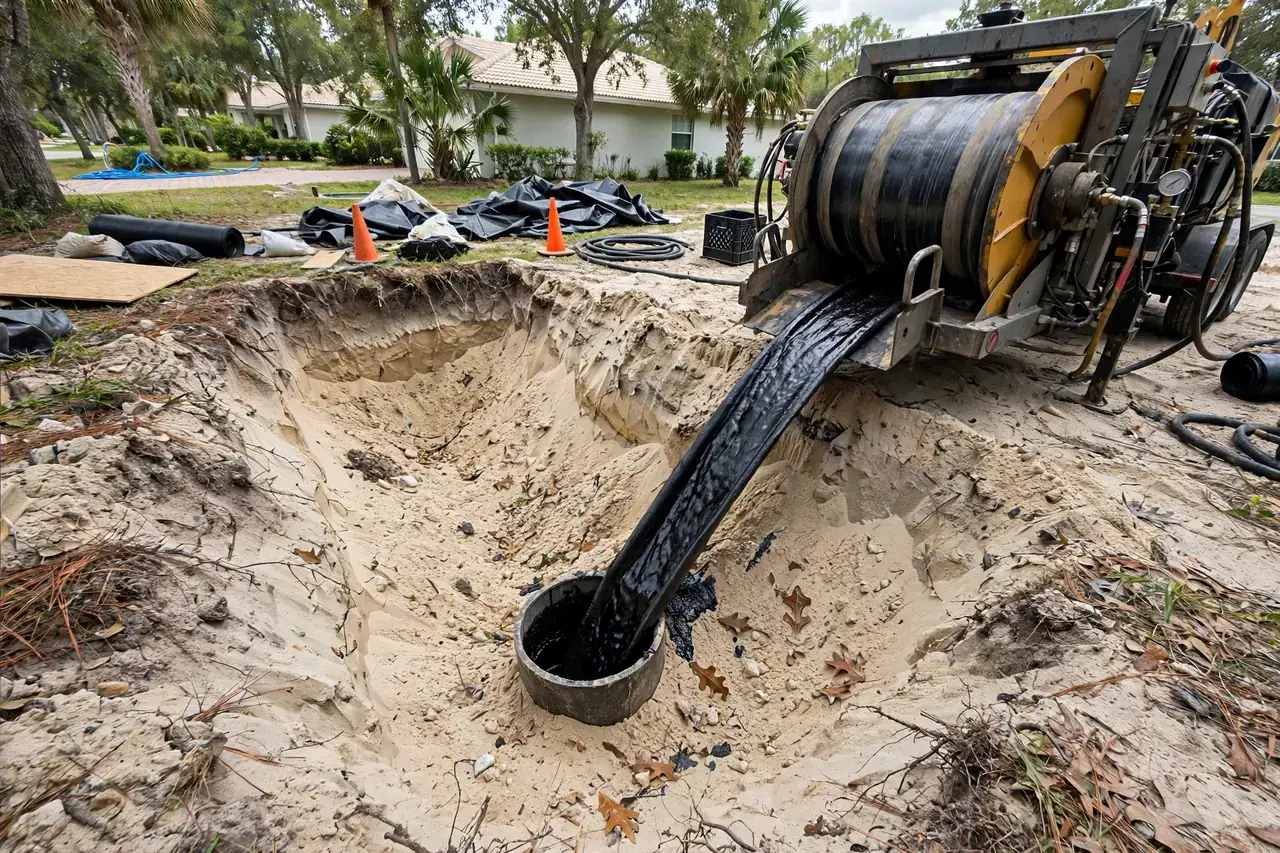
Pipe bursting is exactly what it sounds like: the old pipe is burst apart from the inside, and a new pipe takes its place in the same operation. A conical bursting head, slightly larger in diameter than the existing pipe, is attached to a cable or rod and to the leading end of the new pipe. A winch or hydraulic unit pulls the assembly through the old line. As the head advances, it fractures the old pipe outward into the surrounding soil, displacing the fragments, while the new pipe slides into the void directly behind it.
When the head reaches the exit pit, the old pipe is gone, shattered into the soil around the new line, and a continuous new pipe occupies the original alignment from entry to exit. There is no trench between the two pits. The new pipe is typically high-density polyethylene (HDPE), fused into a single jointless run, which means the finished line has no bell-and-spigot joints for roots to find later.
The elegance of the method is that it uses the failed pipe's own path as the guide. The corridor is already there, already clear of obstructions, already connecting the house to the main. Bursting simply upgrades what occupies it. That is why a camera inspection comes first: we need to confirm the path is traceable and that the defects in the line are the kind bursting corrects.
Why Bursting Fits Collapsed Cast Iron Under Slab
Walk through Gulf Gate or Bee Ridge and you are walking through the prime pipe-bursting territory in Sarasota. These 1960s to 1980s slab subdivisions were built with cast-iron drain pipe buried under the concrete slab, connected to clay or cast-iron laterals running out to the street. Decades of wastewater flow corrode cast iron from the inside out. The interior scales, roughens, and thins until sections of pipe collapse, sometimes gradually, sometimes all at once after a heavy rain saturates the soil above.
When under-slab cast iron collapses, the traditional fix is brutal: jackhammer the slab inside the home, excavate beneath it, replace the pipe, and pour new concrete. Bursting offers a fundamentally different route. The entry pit goes in outside the foundation, the exit pit goes in at the main, and the new pipe travels beneath the slab without the slab ever being opened. The most disruptive part of the old method simply does not happen.
The same logic applies to collapsed clay tile laterals in the historic core, Laurel Park, the Rosemary District, Gillespie Park, where short clay sections with root-invaded, separated joints eventually give way. Bursting replaces the fragile jointed line with a continuous one, which also removes the joints that let the roots in to begin with.
Upsizing: More Capacity in the Same Path
One capability unique to bursting among trenchless methods is upsizing. Because the bursting head expands the old pipe's bore as it fractures it outward, the new pipe pulled in behind can be the same diameter as the old, or the next size up. The surrounding sandy soil displaces readily, which makes Sarasota's Myakka fine sand cooperative ground for this.
Upsizing matters when the original line is undersized for what the house now demands. A 1960s home built with two bathrooms may have gained a third, plus a laundry room, plus fixtures the original plumber never imagined. An undersized lateral cannot be fixed by cleaning; it needs more bore. Bursting delivers that without widening any trench, because there is no trench.
Whether upsizing is feasible on a given line depends on the camera inspection and the site: the condition of the old pipe, the depth, the proximity of other utilities, and the soil. When it fits, it is one of the strongest arguments for choosing bursting over lining, since lining slightly reduces the internal diameter rather than increasing it.
Entry and Exit Pits: What the Work Looks Like
From the surface, a pipe bursting job is remarkably uneventful, which is the point. The visible work consists of two pits and the equipment between them.
The Entry Pit
Opened near where the sewer line leaves the house, typically just outside the foundation. This is where the bursting head and the new pipe enter the old line's path. The pit is sized to the work: large enough to feed the head and pipe in at the correct angle, no larger.
The Exit Pit
Opened where the lateral meets the main sewer, at the property line or easement. This is where the bursting head emerges and where the pulling equipment, the winch or hydraulic unit, is set up.
Between the Pits
Everything happens underground. The old line is camera-verified and cleaned first so the head has a clear run. The pull itself is steady and monitored. When the head arrives at the exit pit, the new pipe is connected at both ends, the line is camera-inspected to verify a continuous, clear run, and both pits are backfilled, compacted, and restored. Most residential bursting jobs are completed in a day.
What Bursting Cannot Fix
Bursting is powerful, but it has boundaries, and you should hear them before you hire anyone.
First, grade. Bursting follows the existing alignment. If the old line has a belly, a sagging section holding water, the new pipe will follow that same sag and hold water the same way. A belly is a slope problem, and slope can only be corrected by opening the ground and re-laying pipe at the right grade. When the camera shows a belly, we recommend sewer line replacement by excavation, not bursting.
Second, access. Bursting needs a clear run between two workable pits. If the line's path is blocked by unmapped structures, or if there is no practical place to open an exit pit at the main, the method may not fit.
Third, the unexpected. Bursting displaces soil outward as it fractures the old pipe. In the loose sands around Sarasota this is normally an advantage, but the line still has to be located precisely and nearby utilities identified before the pull. That locating work is part of every job we do, it is not optional, and it is not skipped.
Bursting in Sarasota Soil and Water Table
Sarasota's ground conditions shape every underground job, and bursting is no exception, mostly in its favor. Myakka fine sand, the state's namesake soil, displaces cleanly around the bursting head, letting the old pipe fragments push outward without the resistance that dense clay would offer. The method was practically made for sandy ground.
The seasonally high water table, zero to three and a half feet across much of the county, is the factor to manage. Two compact pits are far easier to keep dry than a full-length trench: less open excavation, less groundwater to pump, less shoring to install. During the June to September rainy season, when roughly sixty percent of the area's annual rain falls, that difference matters. A bursting job can proceed in conditions that would turn an open trench into a dewatering project.
None of this removes the need for care. Pits in saturated sand still need proper shoring, and work is scheduled with the weather in mind. But the physics of the method, small openings, underground progress, lines up well with what Sarasota's soil and water table demand.
Bursting vs Lining: Which One Fits?
Homeowners often ask which trenchless method is better. The honest answer is that they solve different problems, and the camera footage picks the winner.
- Choose bursting when the pipe is collapsed, badly broken, heavily offset, or made of a material that has failed systemically, or when the line needs upsizing. Bursting removes the old pipe from the equation entirely.
- Choose lining when the pipe is cracked, has leaking or root-invaded joints, or shows internal corrosion but still holds its shape and its grade. Lining rehabilitates; bursting replaces.
- Choose neither when the camera shows a belly or sag. Both methods follow the existing alignment, so neither corrects a grade problem.
Our CIPP pipe lining page explains the lining process in full, and our comparison of the two methods goes deeper into the decision. In practice, the inspection usually makes the choice obvious, which is why the inspection always comes first.
What to Expect on the Day of the Job
A bursting day starts with locating and marking: the line's path, the defect locations from the camera footage, and nearby utilities are all confirmed on the surface before any digging begins. Then the two pits are opened, the pulling equipment is set, and the bursting head, with the new pipe attached, starts its run.
The pull itself is the quiet part. There is no jackhammering, no trench running across the yard, no parade of dump trucks. When the head reaches the exit pit, connections are made at both ends and the camera goes through the new line to verify a continuous, clear, properly graded run. Then the pits are backfilled and compacted, and the surface is restored.
You will have water service interruptions during the work, and we will tell you when to expect them. What you will not have is a torn-up property. Call (941) 344-0088 to schedule the camera inspection that starts the whole process, every bursting job we do begins with seeing inside the line.
Pipe Bursting Across Sarasota
We bring pipe bursting to homes throughout Sarasota and nearby Gulf Coast cities.
Related Reading
Pipe Bursting vs. Pipe Lining: Which Fits Your Sarasota Home?
Pipe bursting vs pipe lining for Sarasota homes: how each trenchless method works and when each wins. Call (94…
Learn more →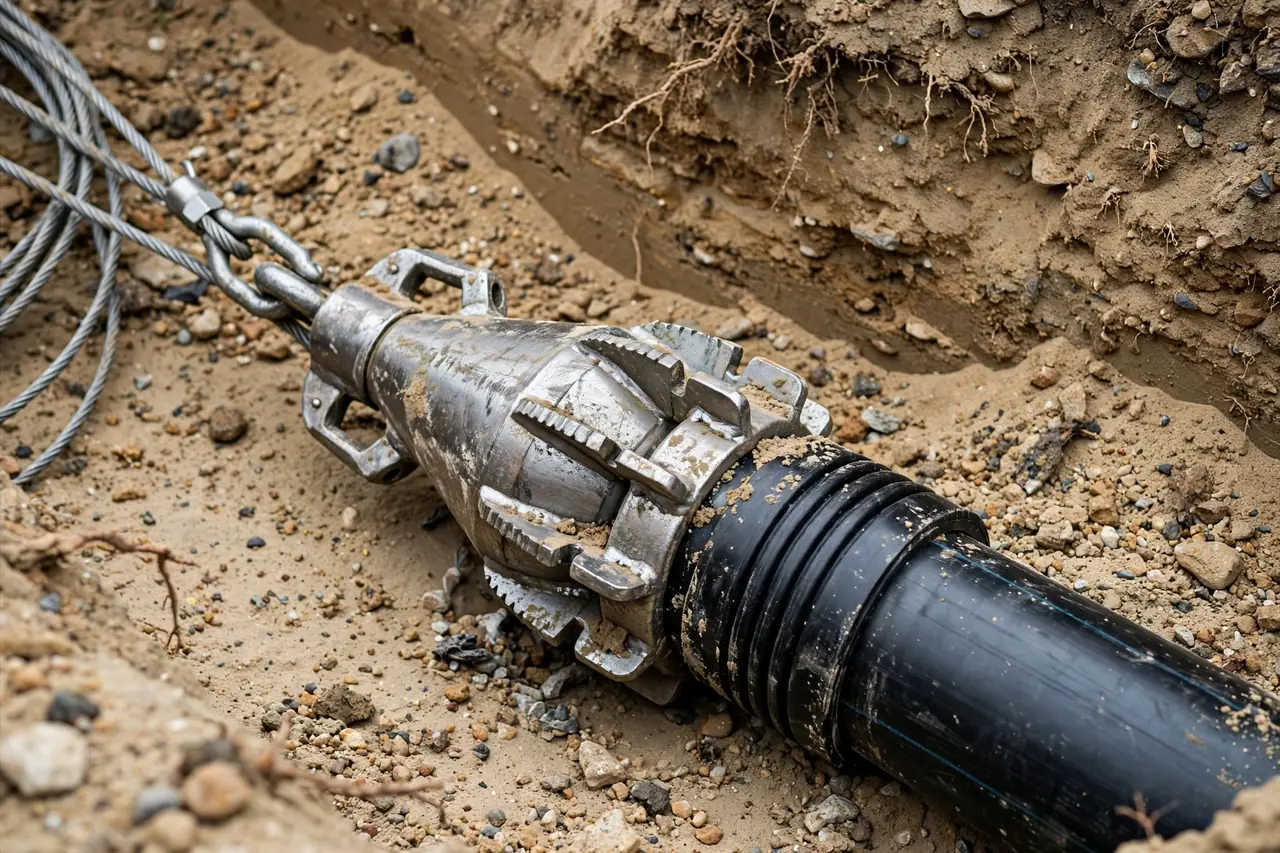
Cast-Iron Sewer Pipe in Sarasota Slab Homes: What to Know
Cast-iron sewer pipe under Sarasota slab homes from the 1960s to 1980s is corroding. Learn the signs and repai…
Learn more →Frequently Asked Questions
Can pipe bursting replace a collapsed sewer line?
Yes. Collapsed pipe is one of the clearest cases for pipe bursting. The bursting head is designed to travel through a failed line, fracturing the old pipe outward as it goes and pulling the new pipe in behind it. Where the old line has collapsed completely, the head still follows the established path of the pipe, which is why a camera inspection first is essential, to confirm the path is traceable.
Does pipe bursting work under a concrete slab?
Yes, and that is one of its main advantages in Sarasota. The work launches from access points outside the home, a pit near the foundation and another where the lateral meets the main, so the bursting head and new pipe travel beneath the slab without any need to break concrete inside the house. This matters enormously for the area's 1960s to 1980s slab homes with cast-iron drain lines.
Will pipe bursting increase my sewer line's capacity?
It can. Because the bursting head is slightly larger than the old pipe, it can pull in a new pipe of the same size or the next size up. Upsizing is useful when the original line is undersized for the home's current fixtures, for example, a house that has added bathrooms since it was built. The camera inspection and site conditions determine whether upsizing is feasible on your line.
How big are the pits dug for pipe bursting?
Two pits: one at the entry point, usually near where the line leaves the house, and one at the exit point, usually where the lateral meets the main. Each pit is only as large as the work requires, big enough to launch the bursting head and receive the new pipe. There is no continuous trench. Both pits are backfilled, compacted, and restored when the pull is complete.
Can pipe bursting fix a sagging or bellied line?
No. A belly is a sagging section where the pipe has lost its downhill slope, a grade problem, not a pipe problem. Pipe bursting follows the existing alignment, so a new pipe pulled along a sagging path will sag in the same place and hold water the same way. Bellies need excavation to re-establish proper slope. Our sewer line replacement page covers that process.
What kind of pipe is installed during pipe bursting?
The new pipe pulled in during bursting is typically high-density polyethylene (HDPE): a continuous, jointless pipe that is fused into a single run with no bell-and-spigot joints for roots to exploit. Jointless construction is one of the main long-term advantages of bursting over simply replacing old jointed pipe with more jointed pipe.
Does pipe bursting damage nearby utility lines?
Bursting follows the established path of the existing pipe, which is already a known, clear corridor. Before work begins, the line is camera-inspected and located, and nearby utilities are identified so the entry and exit pits avoid them. The fracturing force is directed outward into the soil immediately around the old pipe, not transmitted along the surface, so properly planned bursting does not disturb neighboring lines.
How do I know if bursting or lining is right for my line?
The camera footage decides. Bursting fits collapsed, badly broken, or heavily offset pipe, and lines that need upsizing. Lining fits cracked or root-invaded pipe that still holds its shape and grade. If the inspection shows a belly, neither method fits and excavation is the answer. We walk you through the footage and explain the reasoning before any work is scheduled.