Tree Root Removal for Sewer Lines in Sarasota, FL
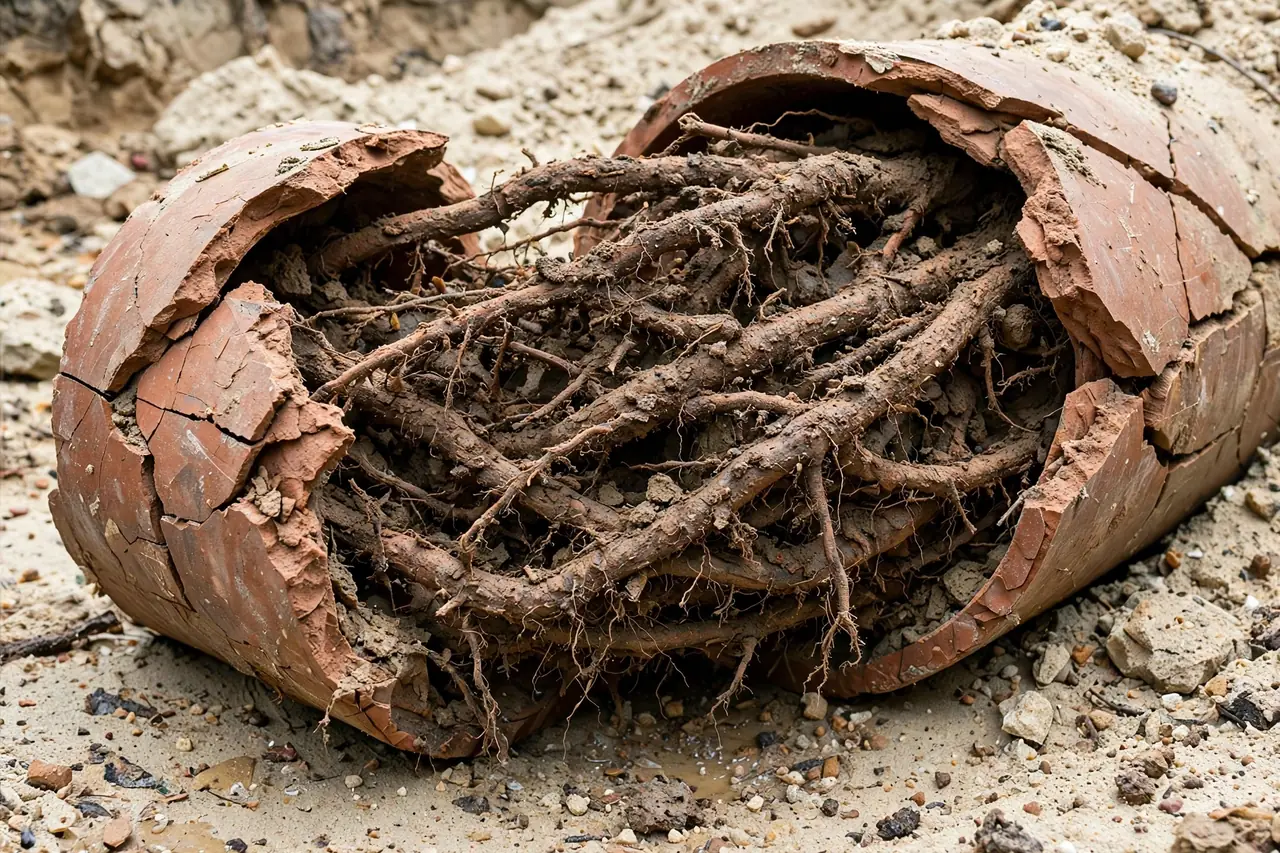
Mature live oaks and ficus trees send roots into the smallest openings in sewer pipes, clay tile joints, separated cast-iron hubs, tiny cracks. We cut the intrusion out, verify with camera, and fix the entry points so roots cannot simply grow back.
How Roots Find Your Sewer Line
A tree does not know your sewer line is there. Its roots are simply following moisture and nutrients, and a sewer lateral, even an intact one, advertises both. Every joint, every hairline crack, every slightly separated hub releases a trace of vapor into the surrounding soil. In Sarasota's sandy ground, where water moves freely, that vapor signature carries, and fine feeder roots, as thin as hairs, grow toward it.
The entry is almost invisible at first. A feeder root slips through a gap measured in fractions of an inch: the seam between two clay tile sections, a cast-iron joint loosened by years of soil movement, a stress crack in an aging pipe wall. Inside, the root finds exactly what it was seeking, a constant supply of water and nutrients, and it thrives. It branches, thickens, and sends out more feeders. What entered as a thread becomes a mass, and the mass does two things at once: it catches solids and slows the flow, and it exerts outward force on the opening it came through, widening it for the next generation of roots.
This is why root intrusion is progressive. A line with minor root contact this year has major root blockage in a few years, and structural joint damage not long after, unless the entry points are sealed. Cutting the roots without sealing the entries is mowing a lawn: the problem returns on schedule.
Sarasota's Worst Offenders: Live Oaks and Ficus
Two trees dominate Sarasota's root-intrusion story, and both are everywhere: the live oak and the ficus.
Live Oaks
The signature tree of Sarasota's older neighborhoods, live oaks are magnificent and massive, and their root systems are proportional to their canopies. A mature live oak's roots extend well beyond its drip line, which means a tree planted in the front yard can be probing a lateral at the property line, or a neighbor's tree can be in your pipe. In the historic core, Laurel Park, the Rosemary District, Gillespie Park, where mature oaks shade clay tile laterals laid a century ago, root intrusion is less a risk than a near-certainty over time.
Ficus
Ficus trees grow fast, root aggressively, and are common across Sarasota's residential landscape. Their surface roots are famously destructive to sidewalks and driveways, and their feeder roots are equally determined underground. A ficus anywhere near a lateral's corridor deserves respect, and a camera.
The combination is potent: old jointed pipe plus aggressive mature trees plus sandy soil that transmits moisture signals freely. It is the reason root intrusion, not corrosion alone, is the most common thing our cameras find in Sarasota's older lines.
Which Pipes Are Most Vulnerable
Not all pipe invites roots equally. Vulnerability is a function of joints, every joint is a potential entry, and of the pipe's condition.
Clay Tile: A Joint Every Few Feet
The clay tile laterals under the 1920s to 1940s historic core come in short sections, which means a joint every few feet along the entire run, dozens of potential entries per lateral. The original joint compounds are long gone, and saturated soil working the sections over the decades opens the seams further. For root purposes, an old clay lateral is less a pipe than a dotted line of invitations.
Cast Iron: Separations After Saturation
Cast-iron pipe has fewer joints than clay, but Sarasota's soil moves. When saturated sand settles, after the June to September rains, after a tropical system, it stresses the hubs, and separated joints become root entries. Add internal corrosion roughening the bore, and roots find both entry and anchorage.
PVC: The Quiet Exception
Modern PVC laterals, standard from the 1990s on in areas like Palmer Ranch and Lakewood Ranch, use solvent-welded joints that fuse into a continuous run. Roots cannot exploit a joint that no longer exists as a seam. PVC is not root-proof, a cracked PVC line is still vulnerable, but an intact PVC lateral near mature trees is dramatically safer than the clay or cast iron it replaced.
Warning Signs of Root Intrusion
Roots announce themselves gradually, and the early signs are easy to dismiss, until they are not.
- Drains that slow down, then speed up, then slow down again, the classic pattern of a root mass that partially clears with plunging or snaking and then regrows.
- Gurgling toilets or tubs when other fixtures drain, air trapped behind a partial root blockage downstream.
- Recurring clogs in the same fixtures, a snake punches through the mass, the mass closes behind it, and the cycle repeats on a shortening interval.
- Backups that track the rainy season, from June through September, faster root growth plus saturated soil plus infiltration through root-opened joints combine into seasonal backups.
- Cleanout overflow or soggy ground above the lateral's path, the line is obstructed and wastewater is finding other exits.
If several of these sound familiar and mature trees stand anywhere near your lateral, the next step is not another round of snaking. It is a sewer camera inspection to see what the roots have done to the pipe, because the remedy depends on the damage, not just the blockage.
Cutting the Roots Out
Removing a root intrusion starts with cutting it out of the pipe, and there are two tools for the job, usually used together.
Mechanical Cutting
A motorized cutter head, sized to the pipe, is run through the line on a cable or rod. Spinning blades shred the root mass and restore flow. Mechanical cutting is fast and effective at clearing the bulk of an intrusion, but it cuts roots flush with the pipe wall, the stumps remain in the joints, ready to regrow.
Hydro Jetting
A root-cutting jetter nozzle directs high-pressure water in rotating streams that slice through remaining roots and scour the pipe's full circumference clean, roots, scale, grease, and debris flushed downstream together. Jetting cleans what the cutter leaves behind and prepares the pipe for whatever comes next. Our hydro jetting page covers the process in detail.
Used together, cutting and jetting return the line to full flow. But they return it to the condition it was in before the roots arrived, joints open, cracks unsealed, entries waiting. That is why root removal is always paired with a camera inspection afterward: the cleaning reveals the pipe, and the pipe determines the permanent fix.
Cutting vs Lining vs Replacement
Once the roots are out and the camera has shown the pipe behind them, three paths present themselves. They are not competing options; they are answers to different conditions.
Cutting Alone: Temporary Relief
Appropriate when the pipe is sound and the intrusion is minor, a maintenance clearing, not a repair. Expect regrowth; plan on repeating it. Cutting alone is never a permanent solution to an established intrusion, because the entries remain open.
Lining: Sealing Every Entry at Once
When the pipe is structurally sound, round, graded, intact, but roots have entered through joints and cracks, CIPP lining is the durable answer. The cured liner forms a continuous jointless pipe inside the old one, sealing every entry point simultaneously. Roots cannot re-enter a line that has no openings. For Sarasota's root-riddled clay tile laterals, lining converts the pipe's greatest weakness, its joints, into a non-issue.
Replacement: When the Pipe Is Beyond Sealing
When roots have separated joints past the point of sealing, collapsed sections, or destroyed the pipe's shape, the line needs to go. Pipe bursting fractures the ruined pipe outward and pulls a new jointless line through its path; where grade is lost or access forbids it, excavation lays new PVC at proper slope. Either way, the new line has no joints for roots to find.
The camera footage makes the choice. Our job is to show it to you and explain which path it points to, not to sell the most extensive option, but the one the pipe actually needs.
Camera Verification After Removal
The post-cleaning camera pass is the most important inspection in a root job, more important, in some ways, than the first one. Before cleaning, the camera sees roots; after cleaning, it sees pipe. Only the second view shows the true condition: the joints the roots entered through, the cracks they widened, the separations they forced, the sections they collapsed.
This verification footage serves three purposes. First, it confirms the removal is complete, no root fragments left to snag solids and restart the blockage. Second, it documents the pipe's condition for the repair decision: lining candidate, bursting candidate, or excavation candidate. Third, it becomes your baseline. If roots ever threaten the line again, a future inspection can be compared against this footage to see what changed.
We record both passes, before and after, and both belong to you. A root removal without post-cleaning verification is a guess that the job is done; the camera removes the guess.
Keeping Roots Out Long Term
Permanent protection has two parts: a sealed pipe and smart planting.
The sealed pipe comes from the repair decision above. A lined or replaced line has no joints, cracks, or separations for roots to exploit, the entries are gone, not just the roots. This is the step that breaks the cycle. Without it, every cutting is a prelude to the next one.
Smart planting protects the new work. Know where your lateral runs, the cleanouts installed with a replacement, or the surface markings from your inspection, show the corridor, and keep deep-rooted trees and large shrubs well clear of it. If you are landscaping a yard with a new or newly lined lateral, choose planting locations with the pipe's path in mind; a little foresight now prevents a root job later.
And if mature live oaks or ficus trees already stand near the line, make the camera a routine: an inspection every few years catches early root contact while it is still a jetting visit, not a repair. Early is cheap. Late is not. Call (941) 344-0088 to schedule an inspection and find out where your line stands.
Tree Root Removal Across Sarasota
We bring tree root removal to homes throughout Sarasota and nearby Gulf Coast cities.
Related Reading
Tree Roots in Sewer Lines: A Sarasota Homeowner's Guide
Tree roots invade Sarasota sewer lines through clay and cast-iron joints. Signs and fixes explained. Call (941…
Learn more →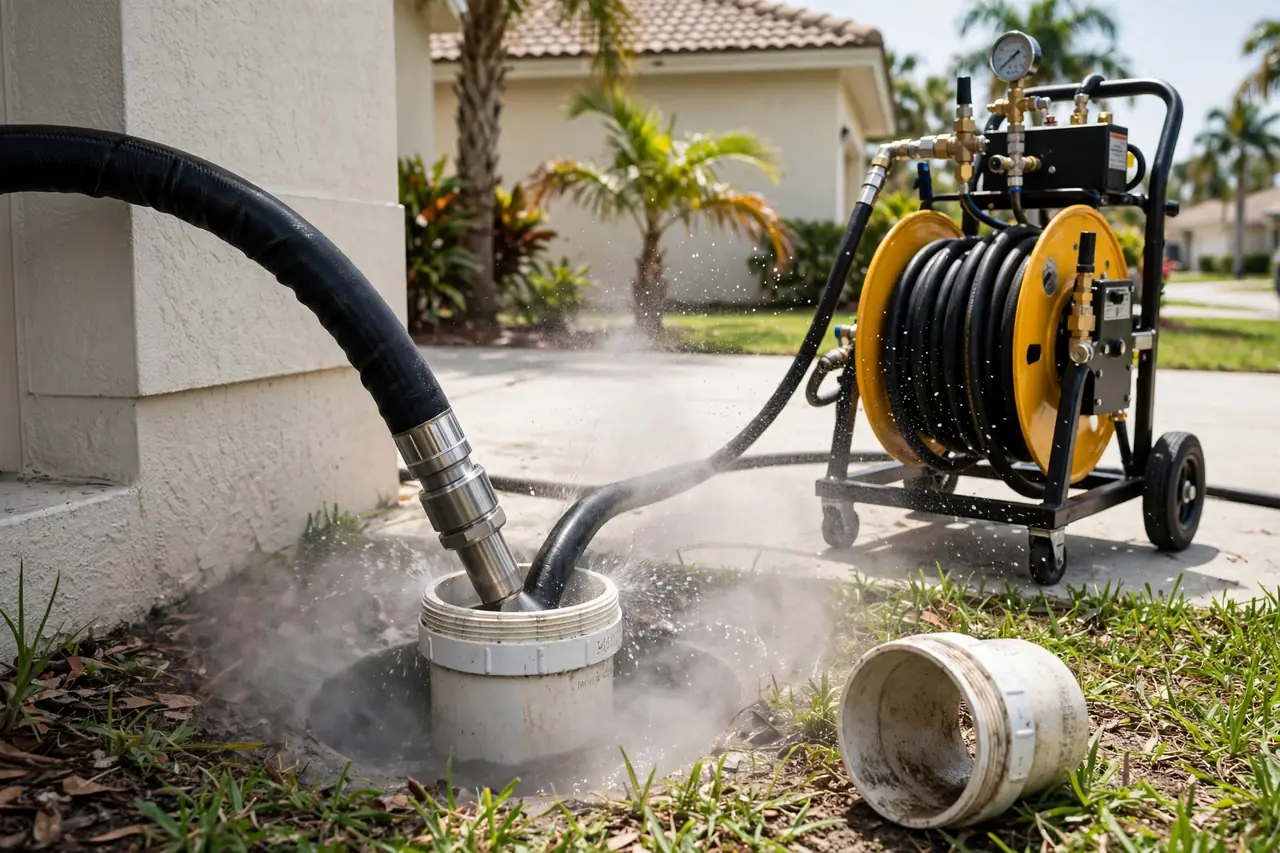
Hydro Jetting vs. Snaking: Clearing Sarasota Sewer Lines
Hydro jetting vs snaking for Sarasota sewer lines: grease, scale, sand and root scenarios explained. Call (941…
Learn more →Frequently Asked Questions
How do tree roots get into sewer pipes?
Through any opening the pipe offers. Clay tile joints, separated cast-iron hubs, and hairline cracks all release tiny amounts of moisture and nutrients into the surrounding soil. Fine feeder roots detect it, grow toward it, and slip through openings far smaller than they will eventually become. Once inside, the root mass thrives on the constant supply and expands, widening the very opening it entered through.
Can roots break a sewer pipe, or just clog it?
Both. It starts as a clog: fine roots catch solids and slow the flow. But roots grow, and growing roots exert force. A root mass expanding inside a clay tile joint can push the sections apart, turning a weeping joint into a separated one. In cast iron, roots exploit existing separations and cracks and widen them. What begins as an obstruction ends as structural damage if it is left alone long enough.
Is cutting roots out enough, or will they grow back?
They will grow back. Cutting removes the intrusion but leaves the entry points, the joints, cracks, and separations the roots came through, exactly as they were. New feeder roots find the same openings, often within a season or two. Cutting is a necessary first step, but lasting relief requires sealing the entries with lining or replacing the damaged pipe.
Does hydro jetting remove tree roots?
Yes. Hydro jetting with a root-cutting nozzle scours the pipe's full circumference, slicing through root masses and flushing the debris downstream. It cleans more completely than a mechanical cutter alone, which is why jetting is the standard preparation before lining. Our hydro jetting page describes the process in detail.
Which is better for root damage: lining or replacement?
It depends on the pipe's condition, which the camera reveals. If the pipe is sound, round, graded, with roots entering through joints and cracks, lining seals every entry at once and is usually the right answer. If roots have separated joints beyond sealing, collapsed sections, or destroyed the pipe's shape, replacement by bursting or excavation is required. The footage decides; there is no universal winner.
Should I remove the tree to protect my sewer line?
Usually not. Once the pipe's entry points are sealed, by lining or by replacement with fused PVC, the tree and the sewer line can coexist. The roots were exploiting openings, not attacking the pipe, and sealed pipe gives them nothing to exploit. Removing a mature live oak is a drastic step for a problem that a sealed line solves. If you are planning new plantings, keep them well clear of the lateral's path.
How does a camera inspection confirm the roots are gone?
The camera goes back in after the cutting is done. The post-cleaning footage shows the pipe walls, joints, and any remaining root fragments clearly, and, more importantly, it shows the condition of the pipe the roots were growing through. That second look is what determines whether the line needs lining, replacement, or simply monitoring. Without it, you are guessing about the pipe behind the roots.
How do I prevent roots from invading again?
Fix the entries, not just the roots. Lining or replacement seals the openings; then keep new plantings away from the lateral's corridor, know where your cleanouts mark the line's path, and schedule a camera check every few years if mature trees stand nearby. Early root contact at a joint is a quick jetting visit when it is caught early, and a major repair when it is not.